From The Victor J Focus Room
How GLP-1 Weight-Loss Drugs Like Ozempic and Wegovy Are Reshaping the Global Health Conversation
Editorial Perspective
For most of the internet’s history, the assumption was simple.
What we saw online was created by a real person, recording a real moment, in a real place.
Photos captured events.
Videos documented reality.
Audio recordings preserved someone’s voice.
The internet was chaotic, messy, and often misleading — but the evidence itself usually came from something real.
That assumption is now beginning to fracture.
A new wave of artificial intelligence tools is making it possible to generate images, videos, and voices so convincingly that even trained observers can struggle to tell the difference.
Welcome to what some researchers are beginning to call the Synthetic Internet.

When Reality Becomes Editable
Deepfake technology uses advanced AI models to generate or manipulate images, videos, and voices.
Faces can be swapped into videos.
Voices can be cloned from a few seconds of audio.
Entire people can be fabricated who have never existed.
What once required expensive film studios and visual effects teams can now be done with consumer software and powerful AI models.
The implications are enormous.
Celebrities have already found their likeness used in fabricated videos.
Politicians have appeared in fake speeches they never delivered.
Businesses have been targeted by voice-cloning scams that mimic executives.
And the technology continues to improve.


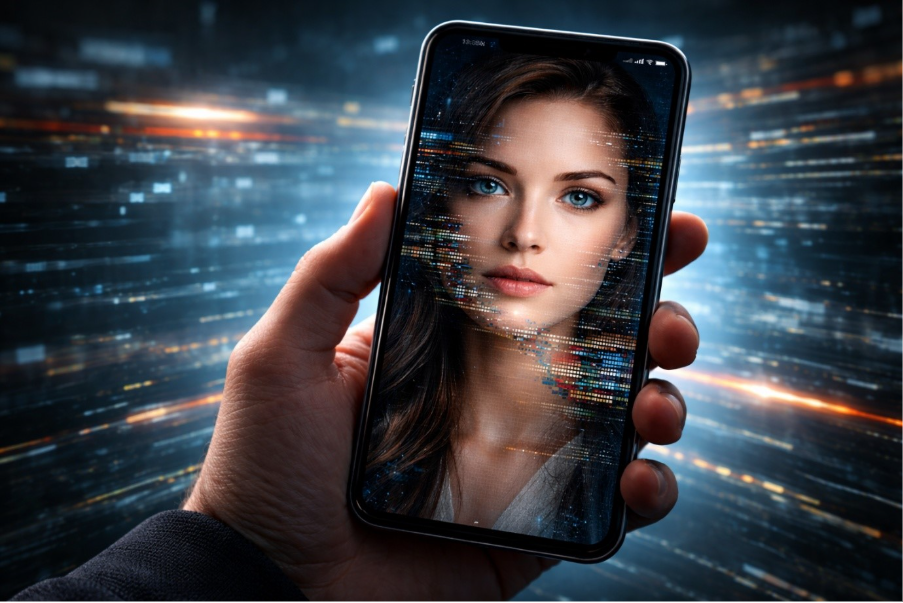
Advanced AI tools can now manipulate faces, voices, and video frames with astonishing precision, making the creation of deepfake media easier and more convincing than ever before.

The Rise of Deepfake Scams
What began as an experimental AI capability is now rapidly evolving into a real-world problem.
Cybersecurity researchers warn that deepfake fraud is increasing at an alarming rate.
Criminals are using AI-generated voices to impersonate family members or company executives.
Fake videos are being circulated to manipulate public opinion.
Synthetic identities are being created to commit financial fraud.
In some cases, entire scams are built around AI-generated personas that appear completely authentic.


From impersonated voices to fabricated identities, deepfake technology is rapidly becoming a powerful new tool in global cyber fraud.

Researchers now warn that deepfake manipulation is occurring on what they describe as an “industrial scale.”
The internet is no longer just a network of human voices.
Increasingly, it is also a network of artificial ones.
Governments Are Beginning to Respond
As synthetic media becomes more sophisticated, governments and technology platforms are beginning to react.
Several countries are introducing rules requiring AI-generated content to be labeled.
Regulators in India and other regions are now exploring policies that could require social media platforms to identify or flag manipulated media.
Technology companies are also experimenting with digital watermarking systems designed to help detect AI-generated images and videos.
But enforcement remains a challenge.
The speed at which AI tools are evolving is often faster than the ability of legal frameworks to respond.
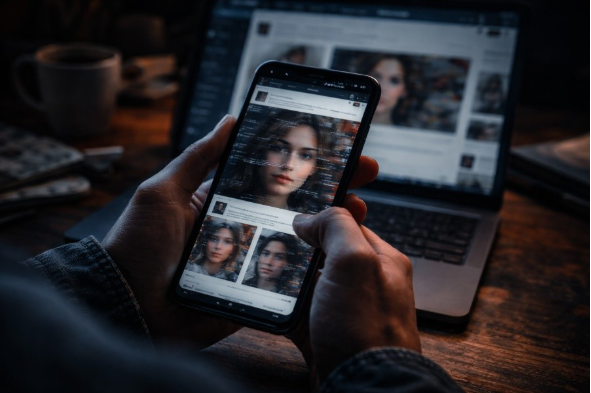
As AI-generated faces and manipulated media spread across social platforms, the line between authentic identity and digital fabrication is becoming increasingly difficult to recognize.
The Human Cost of Synthetic Media
Beyond scams and misinformation, deepfakes are also creating personal harm.
Individuals have already reported cases where manipulated videos and images were used for harassment, reputational damage, or extortion.
In some cases, victims have struggled to prove that fabricated media was not real.
The technology that allows people to generate entertainment and creative content also allows malicious actors to fabricate convincing lies.
As the barrier to creating synthetic media continues to fall, the potential for abuse grows.
A Turning Point for the Internet
For decades, digital literacy focused on identifying misinformation.
Readers were encouraged to question headlines, verify sources, and cross-check facts.
But the Synthetic Internet introduces a deeper challenge.
What happens when the evidence itself can no longer be trusted?
When images, voices, and videos can all be artificially generated with astonishing realism, the very concept of digital proof begins to blur.
The internet may be entering a new phase where scepticism becomes not just useful — but necessary.
Editorial Perspective
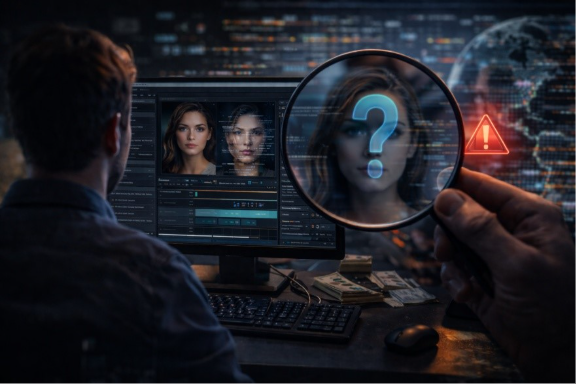
As synthetic media becomes more sophisticated, distinguishing between authentic and artificially generated content is emerging as one of the defining challenges of the digital age.
Moments of technological transformation often arrive quietly before their consequences become clear.
The rise of synthetic media may represent one of those moments.
Artificial intelligence is unlocking remarkable creative possibilities. It allows artists, filmmakers, and innovators to produce content in ways that were unimaginable just a decade ago.
But it is also introducing a profound challenge.
Trust — the invisible foundation of digital communication — is becoming harder to maintain.
Some experts believe that new detection tools, regulations, and digital verification systems will eventually restore confidence online.
Others warn that the pace of technological advancement may continue to outstrip the systems designed to contain it.
What is certain is that the internet is entering a new era – an era where reality itself may need verification.
Whether the Synthetic Internet ultimately becomes a tool for creativity or a weapon for manipulation will depend on how societies, institutions, and individuals choose to respond.
For now, the world is learning a new digital instinct:
Not everything we see online is real.

— From the Victor J Focus Room
Understanding starts here.
The real work begins in the Hub.